- The Federal Government has advanced a $100 million, 400-kilometre gas pipeline project connecting five South-East states, with construction expected to begin in 2027.
- GasSync has identified 150 prospective customers with projected demand of 254 million standard cubic feet daily, targeting first gas delivery in 2028.
The Federal Government has advanced plans for a $100 million gas pipeline across five South-East states. The 400-kilometre network aims to supply industries, attract investment and create jobs, with construction expected to begin in 2027.
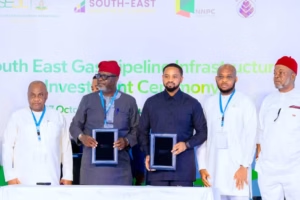
The South-East Development Commission (SEDC) signed an investment agreement on Tuesday in Enugu. The ceremony marked progress towards developing a regional gas distribution network connecting Enugu, Anambra, Imo, Abia and Ebonyi.
Project promoter GasSync expects to begin construction in the first quarter of 2027. It targets first gas delivery in the second quarter of 2028, subject to necessary approvals and funding.
Pipeline targets 150 prospective customers
The proposed network will connect gas resources near the South-East to industrial and commercial centres across the region. GasSync has identified approximately 150 prospective customers, with projected demand of 254 million standard cubic feet daily.
The pipeline will originate in the Ohaji area of Imo State. From there, it will run through Owerri and branch towards Aba in Abia State and Onitsha in Anambra State.
Further extensions will connect Enugu and Ebonyi. According to GasSync representative Callistus Mba, the network will reduce reliance on road transportation of compressed natural gas (CNG) and liquefied natural gas (LNG).
To accelerate delivery, GasSync plans to begin construction at Ohaji and Onitsha simultaneously. The approach follows concerns that building sequentially from Imo could delay supply to other states.
Mba said the company was engaging prospective customers, including manufacturers, power generators and agro-processing businesses. Geometric Power in Abia State is among the companies already involved in discussions.
The project could also support efforts to revive inactive industries in Enugu. In Ebonyi, the pipeline could help develop agro-processing facilities.
Funding and construction preparations underway
SEDC Managing Director and Chief Executive Officer Mark Okoye said the commission completed technical, financial and legal due diligence. Its governing board also approved the project before the commission committed funds.
The commission has committed $3 million to the initiative. It is targeting regional investment participation of up to $30 million, including its initial commitment.
However, the project’s initial phase requires approximately $100 million. Additional financing from governments, institutions and private investors will therefore be important to advancing the network.
Mba said procurement activities had begun, while funding arrangements were progressing towards financial close. Preparations for engineering, procurement and construction were also underway.
Nevertheless, the proposed schedule depends on several outstanding requirements. These include regulatory approvals, right-of-way arrangements, environmental assessments and engagement with host communities.
Enugu State Governor Peter Mbah pledged support for the necessary approvals. He said South-East governors would accelerate right-of-way arrangements and environmental impact assessment processes.
Tinubu links pipeline to regional industrialisation
President Bola Tinubu, represented by House of Representatives Deputy Speaker Benjamin Kalu, described the pipeline as a strategic investment. He said regional gas infrastructure could strengthen manufacturing and unlock economic opportunities across state boundaries.
Tinubu said the project aligned with his administration’s plans for an integrated regional economy. He also highlighted potential benefits for manufacturers in Aba, industrial clusters in Nnewi and Onitsha, and businesses in Enugu.
Furthermore, he said improved gas access could support manufacturing and agro-processing in Ebonyi. It could also connect Imo’s gas resources to the wider regional economy.
The President stressed that the goal extended beyond supplying existing factories. He said reliable energy could enable new industries, industrial parks and investments previously stalled by inadequate supply.
Tinubu also commended SEDC’s $3 million commitment. He said the commission should measure its performance through investment mobilisation, infrastructure development, job creation and improved living standards.
He cited the South-East Vision 2050 framework as a foundation for coordinated regional growth. He also referenced his approval of the South-East Investment Company to attract private capital into strategic projects.
Tinubu urged the commission and its partners to maintain commercial discipline, transparency and environmental responsibility. He also stressed community engagement and strict safety standards throughout implementation.
Governors pledge support for the project
Governor Mbah welcomed the agreement, describing SEDC as an important institution for the region’s industrialisation. He said the initiative could help young people find employment opportunities closer to home.
Imo State Deputy Governor Chinyere Ekomaru, representing Governor Hope Uzodimma, highlighted the state’s natural gas resources. She also noted growing interest from companies seeking gas from the Assa North–Ohaji South development.
Anambra State Deputy Governor Onyekachukwu Ibezim urged communities along the pipeline route to support implementation. Representing Governor Chukwuma Soludo, he said the commission’s success would ultimately depend on tangible benefits for residents.
Similarly, Ebonyi State Deputy Governor Patricia Obila pledged cooperation with the project. Representing Governor Francis Nwifuru, she said improved energy access could help struggling businesses resume operations.
Permanent Secretary of the Federal Ministry of Regional Development Mary Ogbe also backed the initiative. She encouraged investors to explore opportunities emerging from the proposed regional infrastructure.
Ultimately, the project’s delivery will depend on securing financing, completing approvals and coordinating work across five states. If completed as planned, the pipeline could expand gas access for industries and support the South-East’s industrial development.