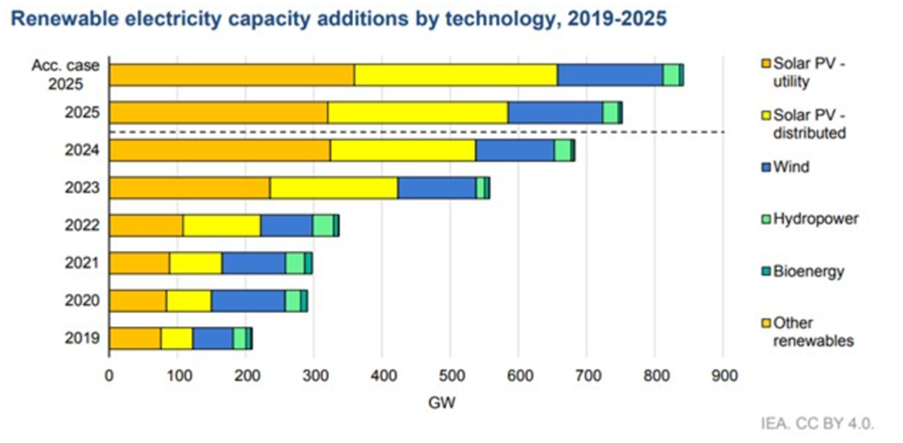
- In its “Renewables 2025” report released on October 7, IEA forecasts that new global capacity will exceed 750 GW, driven mainly by solar power.
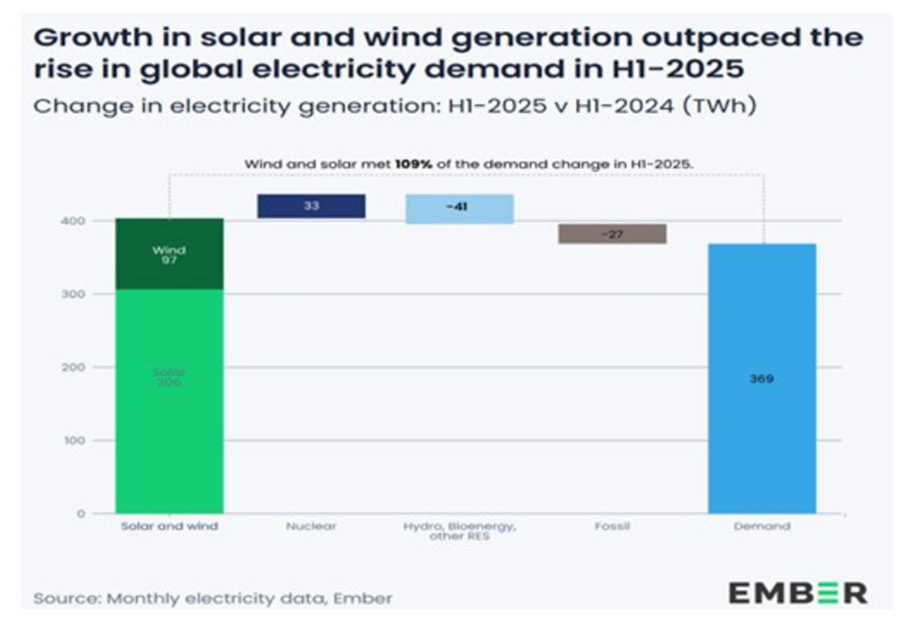
- Ember’s report shows that renewables generated 5,072 TWh of electricity in the first half of 2025, compared to 4,896 TWh for coal.
The International Energy Agency (IEA) projects another record year for renewables. In its “Renewables 2025” report released on October 7, the agency forecasts that new global capacity will exceed 750 GW, driven mainly by solar power.
At the same time, the think tank Ember reports that renewable energy produced more electricity than coal during the first half of 2025. The findings confirm a structural shift in the global energy mix, with solar and wind leading power generation growth.
In 2024, the world added 685 GW of renewable capacity, up 22 per cent from 2023. The IEA expects additions to surpass 750 GW in 2025 under its main scenario, and 840 GW in an accelerated one. Solar energy will continue to dominate growth, while wind energy will contribute between 139 and 155 GW of new capacity.
Most of these additions will be onshore wind, led by China, the United States, the European Union, and India. Offshore wind will grow by 15 GW, mainly in China. Hydropower, after rebounding in 2024, is expected to slow with 23–24 GW of new capacity, mostly from large projects in China and India.
Ember’s report shows that renewables generated 5,072 TWh of electricity in the first half of 2025, compared to 4,896 TWh for coal. For the first time, renewable energy became the world’s top source of electricity, accounting for 34.3 per cent of global generation versus 33.1 per cent for coal.
The growth is driven by record increases in solar and wind, which together covered the entire rise in global electricity demand. Solar alone represented 83 per cent of that growth, led by China, followed by the United States, the European Union, India, and Brazil—trends consistent with the IEA’s projections.
Between 2025 and 2030, Sub-Saharan Africa is expected to add more than 70 GW of renewable capacity, doubling its current total. South Africa will account for over 40 per cent of this expansion, supported by procurement programs such as REIPPPP and corporate power purchase agreements.
In East Africa, new hydropower projects in Ethiopia and Tanzania will drive growth, while in West Africa, Nigeria is set to expand its solar capacity to 10.5 GW. According to the IEA, the removal of fuel subsidies and persistent power outages will continue to accelerate the adoption of distributed solar systems in the country.
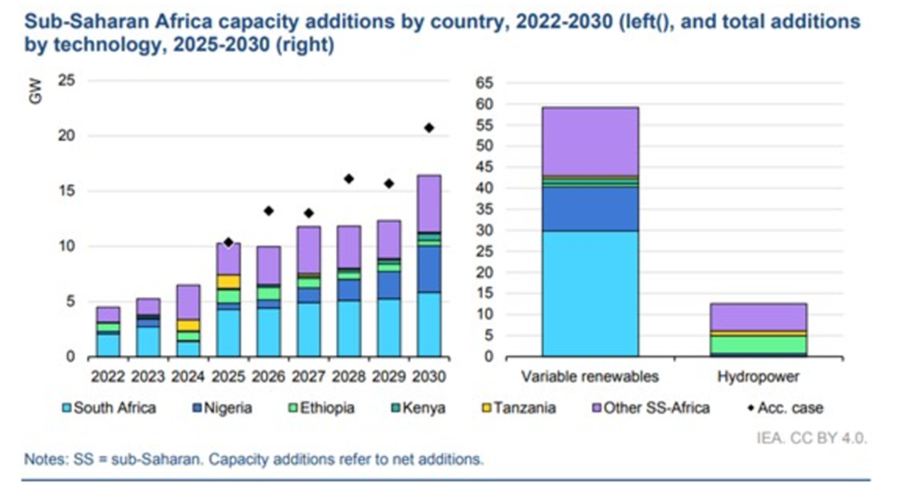
The report highlights a structural shift within renewables. Solar and wind are projected to represent more than 80 per cent of new capacity additions in Sub-Saharan Africa by 2030. Hydropower, long dominant, will fall to 17 per cent of new projects, down from over 40 per cent between 2013 and 2024. Large dams such as Caculo-Cabaça in Angola, Julius Nyerere in Tanzania, and the GERD in Ethiopia will, however, remain key assets.
The IEA notes that Sub-Saharan Africa still faces major obstacles, including weak transmission networks, regulatory uncertainty, and reliance on public financing. These factors significantly constrain renewable expansion despite the region’s vast potential.
Even so, a doubling of installed capacity—though short of the global tripling goal—would mark a significant step forward, with growth likely concentrated in countries best positioned to attract investment.