At her stall in Sabo Market, Ikorodu, Lagos State, Temitope Asore built her wholesale frozen fish and prawns business around a problem she could never fully control, “electricity.” Power reached her stall only a couple of times a week, leaving her constantly vulnerable to outages and the risk of watching her stock—and her income—go to waste.
For a business built around keeping food frozen and fresh, unreliable electricity was more than an inconvenience. It was a threat to Asore’s livelihood.
“There is nothing like being in the frozen food business without electricity,” she says. “It’s not a business.”
So Asore tried a generator. It gave her the power she needed to keep her freezers running and her products fresh, but it came with another problem: “the cost of keeping it on.” With every litre of fuel, more of her earnings went into powering the business.
The generator kept the fish frozen, but it was also steadily eating into the profits she was trying to make. What was meant to be a way out of the power problem was becoming another expense she could barely afford.
The Scale of the Problem
Temitope’s experience is far from unique. Across Lagos and other parts of the country, businesses and traders are struggling with the same choice. They either absorb the rising cost of fuelling a generator or risk losing customers, stock and income when the power goes out. For some, the cost of keeping their businesses running has become so high that staying open is increasingly difficult.
And the burden does not stop at the workplace. At home, unreliable electricity also shapes everyday life, from keeping food fresh and powering essential appliances to the added cost and stress of finding alternative power sources.
According to a World Bank report, more than 85 million Nigerians lack reliable access to grid power. As a result, Nigerians have relied heavily on noisy, expensive, polluting and increasingly unaffordable generators for decades.
PowerFreeze: The Solution to Refrigeration Problems
In response to the plight of Nigerian traders and business owners, Sun King launched a one-of-a-kind solar freezer and expanded its PowerHub capacity. The groundbreaking product launch, held in Lagos on September 11, saw the company unveil a standalone solar freezer called PowerFreeze and expand the PowerHub to 30kW.
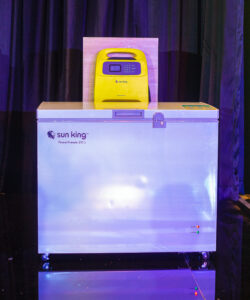
PowerFreeze is a single, integrated product comprising a 210-litre fridge-freezer, solar panels, an energy control unit, and a battery. Switchable between fridge and freezer with the push of a button, PowerFreeze is designed to solve refrigeration problems for both established and small-scale businesses.
Its heavy insulation and five built-in ice batteries are designed to maintain temperature overnight and on cloudy days. At the same time, the control unit doubles as a phone charger and a light source.
Speaking at the product launch, Omoyemi Tuga, Sun King’s Vice President of Sales for West and Central Africa, described PowerFreeze as a product that will help food vendors and other power-dependent entrepreneurs safeguard their investments, increase their profits, and enhance their brand’s reputation.
According to Tuga, while PowerFreeze means improved profits for businesses, it also means less wasted food and more predictable monthly costs for households and families.
“PowerFreeze has shown clear value for the food vendors and households in Nigeria who are already using it, particularly those dealing with food spoilage caused by unreliable power. For small businesses, avoiding diesel generators can materially improve margins. For families, it means less food wasted and more predictable household costs,” he said.
Of course, it didn’t take long for Asore to purchase the product for her business in 2025. In sharing her turnaround story, Asore explained that she now buys in bulk and preserves her stock with the Sun King PowerFreeze.
“Since I’ve been using Sun King, I buy in bulk. My customers know that whenever they come, the products will be frozen and fresh,” she said.
Testimonies like this explain why Sun King has remained Nigeria’s leading solar company since 2017, with 136 shops and 16,000 trained sales representatives. The company has spent the past year expanding its product range towards higher power and higher-value use cases.
Expanded PowerHub Capacity: From Home Systems to Whole Buildings
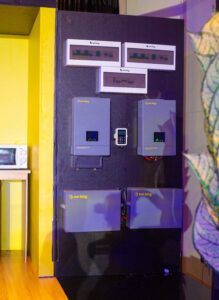
During the product launch, Sun King announced the expansion of its PowerHub solar system, which had previously been available only in 2.2kW and 3.3kW sizes.
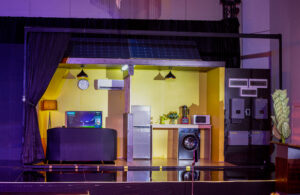
The company has added 5kW, 10kW, 15kW, and 30kW options to its lineup, making the solar system suitable for a clinic, a school block, a light manufacturing unit, or an office that refuses to let the grid dictate its working hours.
Sun King’s all-in-one business model allows customers to choose the inverter size, battery capacity, and panel count that suit their current budget, then add capacity later without replacing the system they have already paid for.
This is the company’s way of keeping customers within the Sun King ecosystem and making it easy for them to increase their generation capacity as their financial strength and power needs grow.
“Our rooftop solar range now runs from a hyper-affordable solar home system all the way to 30kW of inverter power,” said Lisbon O. Ogunsanmi, Sun King’s Country Business Leader for Nigeria.
Shina Adeyemi, Managing Director of Mate Supermarket Ltd, is one of the customers now operating at business scale on the PowerHub system. He describes how the expansion has helped his business overcome the economic impact of the country’s frequent power outages.
“We are no longer troubled by power outages. My energy costs are significantly reduced, and my board of directors are happy with me because costs have reduced and profitability has increased,” he disclosed.
Pocket-Friendly Payment Model
Many Nigerian companies and households want to install solar systems, but can’t meet the financial requirements. This is why Sun King’s EasyBuy plan is a welcome development, allowing customers to access both products without breaking the bank.
With this pocket-friendly instalment plan, payments for PowerFreeze start at ₦120,400 per month over 20 months, while the entry-level PowerHub Pro 5kW system starts at ₦304,400 per month over the same period.
In a market where the upfront cost of solar equipment is usually the biggest barrier to adoption, spreading payments will go a long way towards encouraging entrepreneurs to invest in solar systems.
Beyond the instalment payment model, Sun King serves as a single point of contact from sale through to service, designing, installing, and servicing every system itself. This makes it easier for customers to access reliable installers, financiers, repair technicians, and after-sales teams across its operating zones.
Perfect Timing
The timing of Sun King’s launch couldn’t be better, as there is a broader shift in how off-grid solar is discussed in Nigeria. Stakeholders now view off-grid solar as a more reliable option for businesses and households that are only nominally connected to the grid.
Nigeria was named among the largest markets driving Sub-Saharan Africa’s small-scale solar boom, as clean energy investment across the region reached a record $13.5 billion in 2025.
According to the Global Solar Council’s Africa Market Outlook, Nigeria installed about 803 megawatts of new solar capacity in 2025 alone, making it Africa’s second-largest solar market after South Africa, with cumulative installed capacity reaching roughly 1.19 gigawatts in 2025.
Analysts expect this momentum to continue, with Nigeria’s renewable energy market projected to grow significantly over the next decade as declining battery costs, expanding financing options, and persistent grid unreliability push more households and businesses toward solar.
Sun King’s PowerFreeze and expanded PowerHub range are part of the solutions increasingly utilising solar as a major power source. With national grid generation still dominated by natural gas and hydropower, individual solar systems remain Nigerians’ most realistic route to a reliable power supply.
Conclusion
Sun King’s PowerFreeze and expanded PowerHub range come at a time when off-grid solar in Nigeria is increasingly moving beyond a backup option to become a more viable, reliable source of power for homes and businesses.
With over 85 million Nigerians still grappling with unreliable electricity and businesses seeking ways to reduce the cost of powering their operations, the demand for solutions that provide dependable, affordable energy is likely to continue growing.
For customers like Temitope Asore and Shina Adeyemi, the value goes beyond simply keeping the lights on. Reliable power means less food loss, lower energy costs, greater certainty in daily operations, and, ultimately, more room for businesses to grow.
The bigger question now is how solutions such as PowerFreeze and the expanded PowerHub range can be scaled to reach more businesses and households that need reliable power. If they can, solar could play an even greater role in helping Nigerians protect their livelihoods, reduce energy costs and turn unreliable power from a daily constraint into an opportunity for growth.